
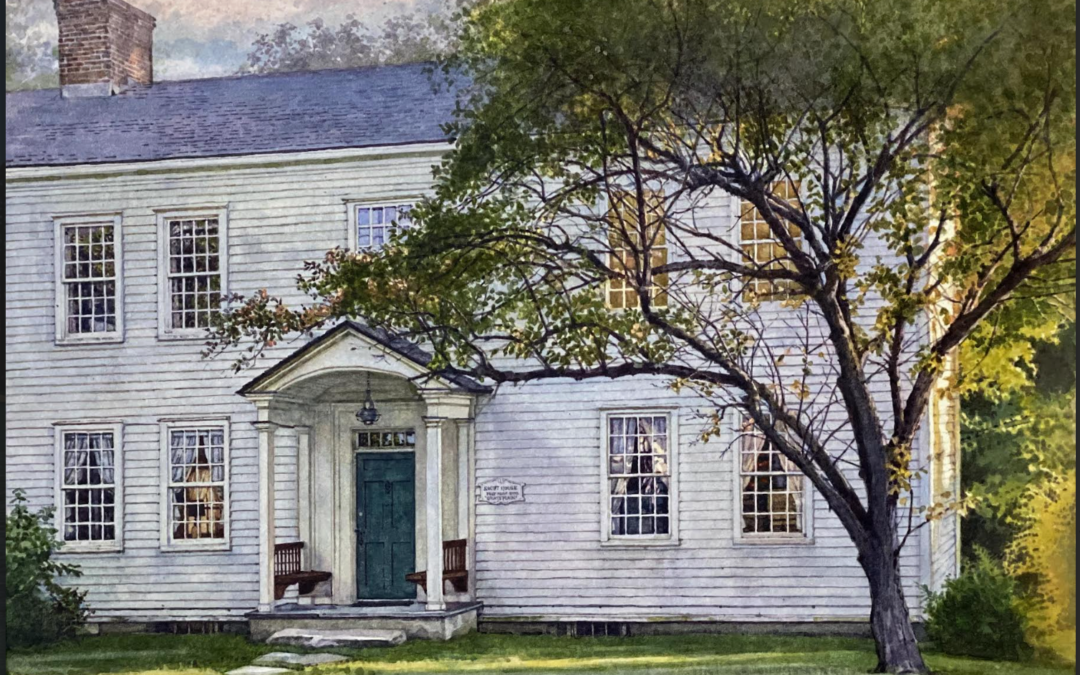
Over the last several months, leadership at the Kent Historical Society has served on the Swift House Investigative Committee at the request of the first selectmen. The Committee was charged with providing input and assistance to the selectmen on a redesign, repurpose and ADA-compliant upgrades, as well as developing a secondary comprehensive plan to sell the building if the town decides to dispose of it.
Regardless of the path the town decides to take, the Committee’s first recommendation is to place a protective covenant on the structure, as well as to hire a consultant to coordinate an application for inclusion on the National Register of Historic Places. These two steps are crucial not only to demonstrate the significance of our historic building, but to ensure it will exist in perpetuity. It also illustrates the worthwhile investment the Swift House is in the world of Historic Preservation. Many funders both public and private require either a State or National listing in order to be eligible for grants. They also require matching funds as a demonstration of the town’s commitment to preserving the places that matter.
The affection and care townspeople feel for the Swift House is evident: through the survey conducted, it is clear that the vast majority wish that the town retain it. One respondent declared the Swift House as “an important asset which housed people who [were significant participants] in Kent’s beginning. We are lucky to have it still. We have an obligation to preserve it.“
We are confident that our next recommendation, to form a 501(c) 3 “Friends of the Swift House” organization will be implemented with enthusiasm. A partnership with a not-for-profit will alleviate the burden of stewardship for the town, ensure careful planning towards a thoughtful repurposing and streamline fundraising efforts.
Yet, none of this can be accomplished without the financial commitment of the Town.
If retaining the Swift House for community use is important to you, we strongly encourage you to attend the next hybrid Board of Finance meeting on Friday, May 15th at 6 PM in the evening. Let the Board know you would like to keep the upgrades to the Swift House in the budget so future fundraising is plausible. Please note that this is a public hearing; the budget will be presented to the public for a vote on May 29th. Constituents must be in attendance in person to vote.
A brief historical overview of the Swift House
The significance of the Swift House is linked as much to what its inhabitants contributed to Kent as it is to the features of the house itself. In 1743, two Swift brothers, Jabez and Nathaniel, along with their cousin Reuben, arrived in Kent from Sandwich, MA. Jabez and Reuben settled their big families on the “Great Plain” – the large flat area south of Flanders that includes our current downtown – and each played major roles in the beginnings of Kent. Charles S. Grant, in his critically acclaimed Democracy in the Connecticut Frontier Town of Kent, wrote that the first actual settlers of our town were “vigorous, resourceful and prosperous.” Jabez (1700-1769) especially fit that bill. Jabez was the largest single taxpayer, and was appointed to the school committee (to build schools and appoint teachers), the committee to lay out the Sixth Division of the 50-acre lots, the committee to lay out highways, and the committee to set the tax rates. He also was elected Selectman in 1750, was appointed Moderator of the Town Meeting, and was an influential member of the Congregational Church. In 1757, he was elected to be the Town of Kent’s Representative to the Colonial Assembly, a position he held for several years, and in which he was succeeded by his son Elisha from 1768 to 1770. Three other sons, Heman, Jireh and Jabez, Jr. served in the Revolutionary War, with Heman becoming one of George Washington’s most trusted Generals, and an honored citizen of Cornwall. Jabez, Jr. served in Boston, and then settled in Salisbury as an attorney. Heman served in the Continental Army under Washington during the infamous encampment at Valley Forge in the winter of 1777-1778, which was a critical turning point of the war, where despite conditions and disease that killed nearly 2,000 soldiers, the army was transformed into a disciplined, professional fighting force through the training of Baron Von Stueben. Heman also came to the aid of the wounded Lafayette in the Battle of Brandywine. 39-year-old Jireh was mortally wounded in the Battle of Quebec while serving with Benedict Arnold (before that man turned traitor), and is buried in Good Hill cemetery. The Swift family dedicated their lives to their town and their country in many ways.
The Swift House as it appears today is actually comprised of three distinct circa-1790 buildings that were attached in the early stages of their existence. They were set on the foundation of Jabez Swift’s first (much smaller) house, built circa 1743. The 1790 date was chosen based on specific architectural features, such as the fireplace surrounds as well as the construction elements visible in the attic, where the evidence of the three distinct houses are most easily discerned. The exterior appearance has not been changed. While the interior has had partitions removed over time, it is also largely unchanged. Exactly when those houses were moved and joined to create our present Swift House cannot be determined from the land records, but it is clear from evidence in the cellar foundation that Jabez’s original required 18’x18’ structure was part of what is now the northeast corner of the house.
A May 2024 inspection of the house by preservation officers from the State Historic Preservation Office (SHPO) resulted in the recommendation that the house be listed on the National Register of Historic Places. Their report reads, “The house, which is comprised of three structures dating from the mid through early 19th centuries, is associated with the Colonial settlement of Kent. It retains 18th-century timber framing in the earliest portion of the structure, along with Federal style exterior details, historic fireplaces and trimwork. The architecture is distinct on the interior as a surviving example of a dwelling enlarged during the 18th and 19th centuries, through the merging of other existing structures, rather than new construction.”
The Swift House is one of only two 18th century houses in Kent open to the public, the other one being the Kent Historical Society’s Seven Hearths. It is a treasure, and deserves to be preserved.